Very little is reliably known about the life and professional existence of Susche-Eleell Ditraine before the 2198. Official, yet subsequently contested, records indicated a highly distinguished academic career. Ditraine was credited with numerous published papers across various scientific disciplines, ostensibly produced during her tenure with a range of prominent organisations and advanced educational institutions. Her reputation, at the time, was one of a rising star in her field, an intellect of significant capacity whose contributions were widely cited.
However, the catastrophic terminal disruption events that engulfed the Central Processing Hall in 2200, and Ditraine's direct, though ambiguous, implication in the resulting death of Colonel Gundel Haan, shattered this carefully constructed narrative. The immediate public enquiry that followed the disaster was tasked not only with determining the cause of the system failure but also with investigating the personnel involved. What they discovered regarding Ditraine was a profound, systematic absence of verifiable history.
The investigative teams could not locate a single piece of reliable, third-party information to corroborate her claimed academic background and work history. Detailed interviews were conducted with staff and administrators across the organisations and educational institutions cited in her extensive resumé. The result was a complete and unsettling blank. No documentary evidence could be found in institutional archives, and even anecdotal memory failed. Individuals who should have worked closely with her, attended her lectures, or collaborated on research papers claimed no recollection of a Susche-Eleell Ditraine ever having been employed or associated with their establishment. It was as if her entire pre-2198 professional life had been a fabricated existence existing only in her own submitted documentation.
Following the dead end encountered in the formal investigation channels, background checks were widened significantly, employing less conventional search parameters and more speculative data-mining techniques. These efforts eventually uncovered fragmented and uncorroborated sightings of an individual matching her description within the largely autonomous and less-regulated Eastern Zone. These fleeting records suggested that the person believed to be Ditraine was a human female of asio-pacific descent, approximately twenty-five years old, operating under circumstances that remained opaque.
Her next substantial appearance in official records was dramatically different. She was catalogued as a "sender-terminate," a designation indicating a body rendered non-viable but whose conscious data stream had been salvaged via a Micro Petite Sender. She was one of the few survivors rescued from the devastating attack on the Setright Science Facility, R&Red from the covert research installation. The rescue operation was executed by the vessel Saint Mungo and its Haan - Sinter pair crew, a unit known for its high-risk recovery missions.
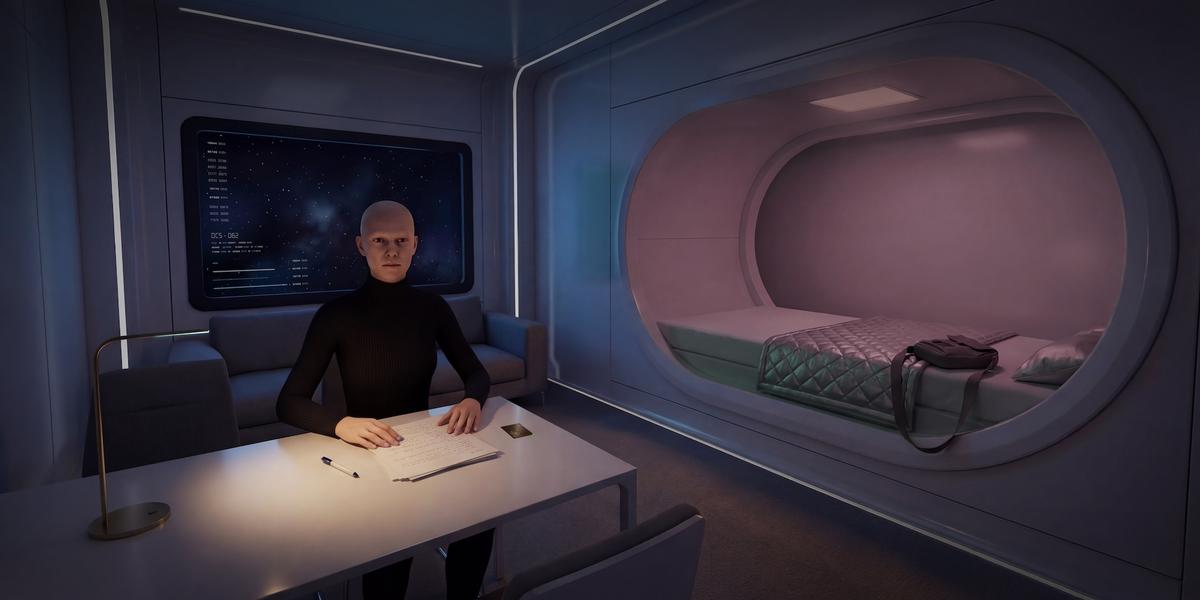
Ditraine, at the time of her rescue, purported to have held the role of Senior Biologist at the Setright facility. Given the extent of the damage to her physical body, which was deemed beyond any possible repair or reconstruction, the decision was made to virtualise her consciousness into an experimental, artificial person substrate, effectively creating a completely synthetic iteration of the human being who claimed to be Susche Detraine.
However, the mystery surrounding her identity only deepened post-virtualisation. Further interviews conducted with anyone who might have encountered her at the Eastern Zone, within the organisations she claimed to have worked for, or even her colleagues at the Setright facility, yielded largely inconclusive, frustratingly vague outcomes. Few commentators could offer a clear, definitive memory of ever having seen her, leading many investigators to suspect that the entity known as Susche-Eleell Ditraine was not merely an unreliable narrator of her own past, but a deliberately constructed identity whose true origins still remained completely obscured. Media attention has lead some commentators to believe Susche was part of a deep undercover Co-Lantsk operation that predated the official Visitors' arrival in 2200, although this speculation remains a unsubstantiated fringe opinion.