
Chris Barnardo

Send me amessage

If you would like to get in touch, please send me a message. I will respond as soon as possible. Thank you.

Ark Main Reception 183

The Blog

The Blog

Ark Main Reception 183

CAPACITY: 1,745,000 people | RETAIL OUTLETS: 12,681 | RESIDENTIAL: 546,133 | SENTIENCE LEVEL: MI Beta plus

From the Blog

Keep up with all the latest news from me and Advances in the Art of Being.

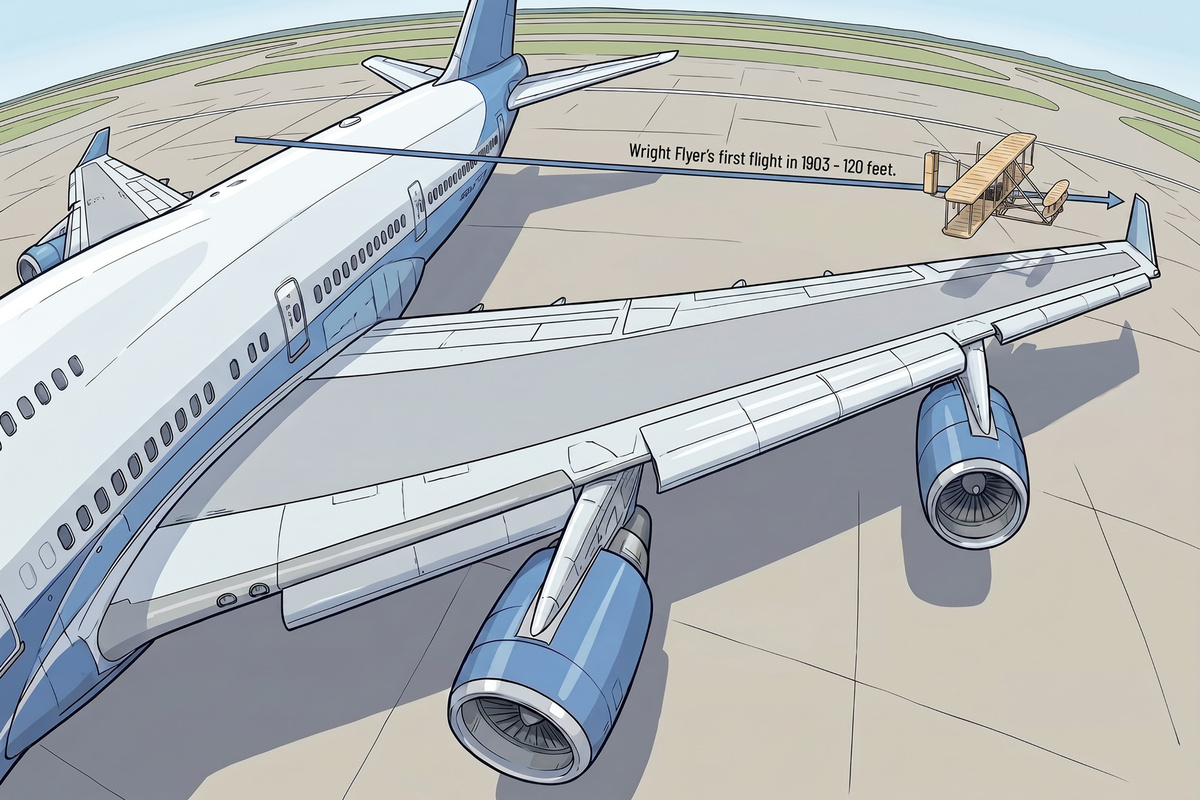
The Wright flyer's first flight just over half a Jumbo Jet's wing span

The future is not more of the same

The post present will be unrecognisable

When writing science fiction it is almost impossible to predict the distant future with any sensible confidence. However, what I can say with pretty much total conviction, is that the future will definitely not be a bigger, faster version of the present. 

In 1903, a correspondent writing in the New York Times made a prediction. Human flight, he confidentially asserted, was so far beyond our reach that it might take mankind anywhere from one million to ten million years before the technical challenges could be solved.

It sounds absurd now, but by some reckoning, it was then felt to be a reasonable conclusion. For centuries, humans had dreamed of taking to the skies in heavier than air flying machines. Since the late 1700s people had of course flown in hot air and hydrogen filled balloons. In fact,  in 1862 two intrepid aeronauts had ascended as high as 37,000 feet. But despite these successful balloon flights, heavier than air, controlled, powered flight had repeatedly eluded the world’s brightest engineers’ best efforts, and was thus presented as an impossible dream.

Yet, less than seventy days after that New York Times article, two bicycle mechanics from North Carolina proved it spectacularly wrong. In their first 12 second flight, the Wright brothers changed that future, in a metaphorical blink of an eye, erasing what had been thought to be millions of years of progress. At the same time, they changed the world into a completely new place that just a couple of months before no one could have imagined.

After that first step, the development of powered flight literally took off, and in just 66 years, the jet-powered 747 Jumbo, was cruising at 650 mph, 40,000 feet above sea level, ferrying 400 passengers across oceans from continent to continent.  

Our problem is not our lack of imagination, but the notion that the post-present world will continue to be more or less the same as we know it to be now. Of course we hope (even believe), that the future will bring some, maybe even vast improvements, but few imagine the inevitable wholesale paradigm shifting changes that will make our future wholly unrecognisable to us.

We expect the future to be largely a continuation of the present, roads, airports, cities, jobs, money; we feel these things are sure, certain and dependable; but they are not. Look back one or two hundred years and mostly those things did not exist in a way that we would recognise today; spin forward one hundred years and in all likelihood they will not exist at all. Airports will lie empty or redeveloped, roads obsolete, money a thing of the past. Entire industrial complexes, built over decades, will contract or vanish within a generation.

So, right now somewhere, perhaps already in development, just round the corner, is the rocket engine equivalent of the Wright Flyer’s powered flight, a technology to fundamentally change the world and everything in it. It’s a breakthrough that will make our current puny chemical rockets feel as outdated as horse-drawn carriages and present us with opportunities the likes of which we can hardly even imagine. Roll on the exciting and extraordinary world of Advances in the Art of Being.

22 May 2026

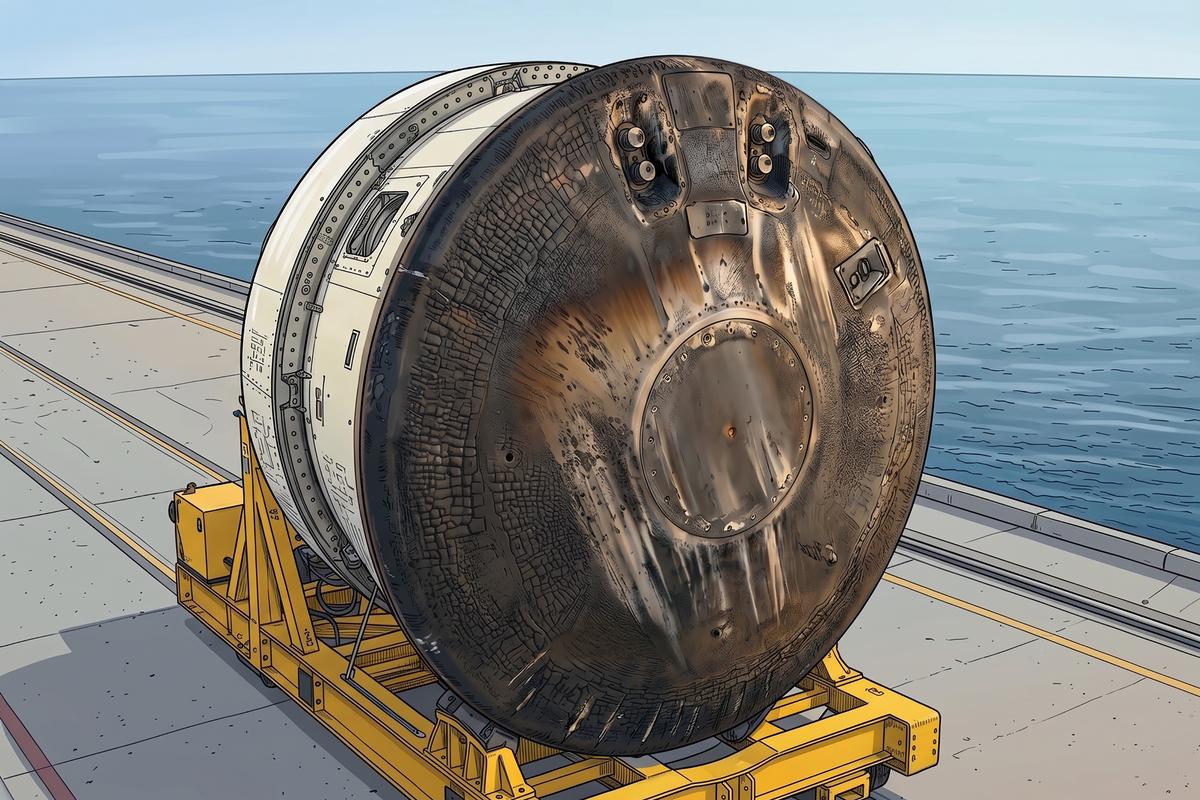
Orion capsule heatshield

No more blasting rockets into space

then letting them burn through heat shields on the way back home

In 2200, a spaceship the size of a building lifts gently from the ground, almost effortlessly, climbing through the atmosphere. Within minutes it has crossed the Kármán line and is heading into space. At the end of its journey, it returns the same way, slowly sinking back into the atmosphere. In 2026 state-of-the-art rockets don’t ascend, they literally blast their way out of the atmosphere. Sitting on top of thousands of tons of explosive fuel, shaped like missiles, today's rockets are designed to hurl a tiny payload a few hundred miles skyward and into orbit before their propellant runs out. At the end of the journey, all that remains is a tiny capsule which slams back into the atmosphere at Mach 25, and having to rely on friction with the air to slow it down and a thick heat shield to survive the resulting inferno of re-entry.

The difference between these two visions of spaceflight is often imagined as technological, but in reality, it comes down to something far more simple... energy.

Chemical rockets are astonishingly powerful, but incredibly inefficient. To send a crew of just four people on a loop around the Moon requires thousands of tonnes of propellant. The problem is that the fuel itself is heavy and the rocket must lift all of it. The rocket needs more fuel to lift the fuel it needs, and so on. By the time the maths is done, about 90% of the mass of the rocket is just fuel needed to lift the fuel for the journey.

This creates a hard limit, the rocket can't simply ease its way into orbit, it has to race against gravity in a rush to accelerate to the point where it can coast at the 11 kilometres per second that is needed to escape the Earth's gravitational pull and to get into orbit, before its fuel is exhausted. There is no hovering, no gradual climb, it is a single, violent and mechanically-stressy sprint into space.

But what if the spaceship had access to a supply of unlimited energy? Well, then the entire paradigm would change. A spacecraft could generate continuous thrust without the need for explosive force. Instead of fighting to overcome gravity in a furious eight minute engine burn, it could overcome it steadily at a much more leisurely pace.

In that world, spacecraft wouldn’t need to be arrow-shaped or aerodynamically constrained in any way. Ships could rise slowly through the atmosphere, transitioning seamlessly out into space. On their return, they wouldn’t need to be designed to endure plasma, half as hot as the surface of the sun, as they slammed into the edge of the atmosphere, and as a result there would be no need for single use heat shields, because spaceships could simply decelerate before reaching the edge of the atmosphere, re-entering at a controlled speed.

Once we are free of the tyranny of carrying all the fuel needed for a space flight, the implications become even more exciting. A spaceship capable of maintaining constant acceleration, for example at a comfortable 1g, could reach Mars in little more than a day and a half. Yes, you read that right... Mars would only be one and a half days away.

In Advances in the Art of Being, this transformation arrives with the invention of the energy pump, a breakthrough developed in 2058 and approved for widespread use by 2096 (see the timeline). The energy pump reinvents traditional local space travel within our solar system, bringing the all those far off places that we would love to reach, easily within our grasp, because the truth is, we already know how to build the vessels we would need to take us there. We already have the technology to build machines of extraordinary scale and complexity, aircraft carriers, nuclear submarines, and cruise liners like floating cities. So the missing piece is not engineering, it’s just energy. And with an unlimited supply of energy at our disposal we can throw out the heat shields, the pointy spaceships and the thousands of tons of fuel needed for each trip and joyride around the solar system in a range of exotically shaped floating city-sized spaceships, setting up and supplying off world bases wherever we like.

4 May 2026

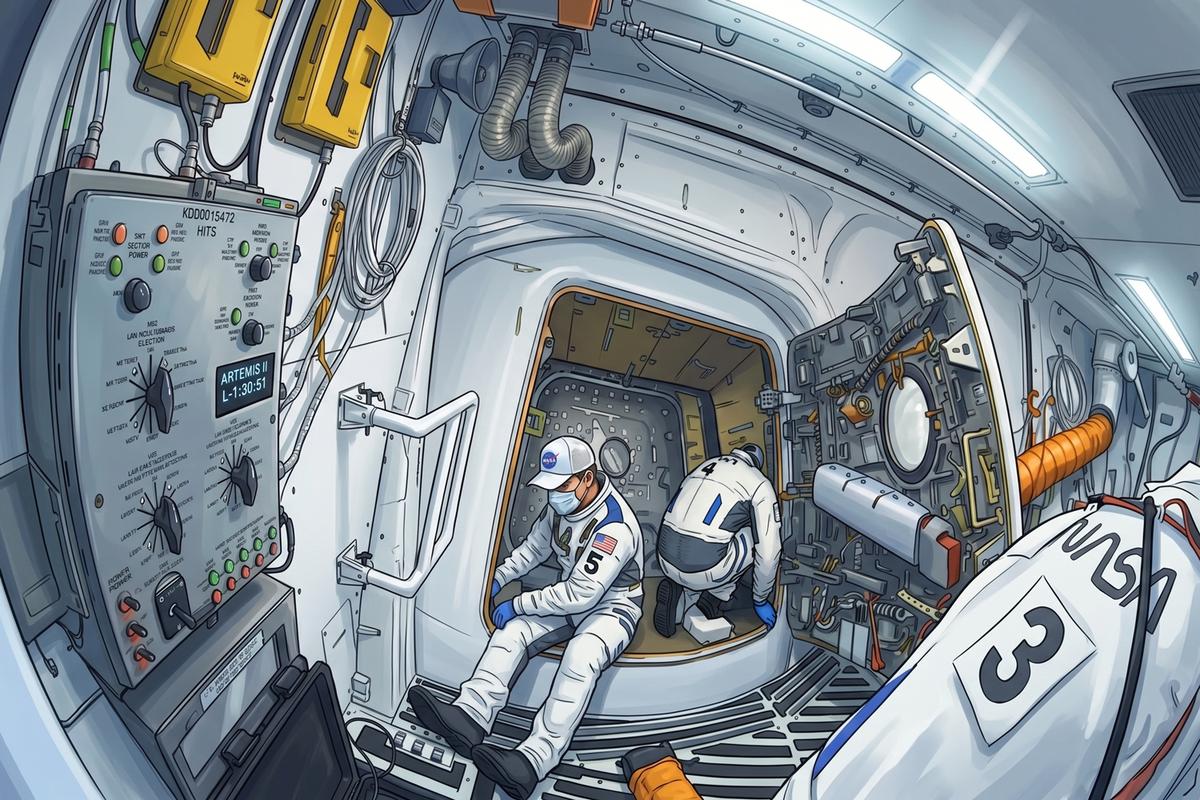
Support crew gets Orion ready for take off

Honey, I’m just nipping to the store

The simple act of travelling

“Okay, don’t forget to check the fuel level with the dipstick, and while you’re under the bonnet, check the oil level. Oh, and also you should check that the oil greaser is set to open. And remember to lubricate the chassis, actually that’s a two-man job. I’ll come out and help. I’ve run a kettle of water for you to top up the radiator, and I’ve made up a spare bottle for you to take with you, just to top it up again after you’re done at the store. Tell you what, I think I better get it started for you, especially after last time when you broke your thumb on the crank handle.

“It’ll only take twenty or thirty minutes for the full checks, the greasing, and the warm-up, and if everything goes smoothly, we should have you up and running and on your way in no time at all.”

This was how it was for the lucky few who owned a car, a little over a century ago at the true birth of the automobile age. The sheer effort, the required mechanical knowledge, the necessary physical strength, and the meticulous pre-trip rituals, putting to one side the cost, were all a significant barrier to entry. Every journey was truly an event, a minor expedition preceded by a mandatory checklist of fluid levels, lubrication points, and the hope that the temperamental engine would catch on the first few pulls of the starting crank.

Spin forward a century and a quarter, and the modern motor car is a universe away from that greasy, arduous process. Cars, already incredibly easy to operate by comparison. Starting at the press of a button, they are now about to take away even the last tiniest vestige of pre-drive, check-your-mirrors preparation, and replacing it all with a simple spoken request: “Drive me to the store.” Before long, the vehicle will handle all the safety checks along with the navigation, the roadcraft, hill starts, braking, and parallel parking, turning the complex act of driving into the simple act of travelling and then arriving. The need for a roadside tool kit or a spare bottle of radiator water is a romantic myth of a bygone age. It was this incredible march towards simplicity and automation that struck me profoundly while watching the preparations for humanity’s return to the Moon.

Watching the preparations for the first crewed trip aboard the Orion spacecraft, as the Artemis II mission astronauts prepared to travel to the Moon and back, only for the four hours that lead up to the launch, I was taken aback at the sheer, overwhelming amount of time and effort it took just to climb into the spacecraft and get going. This four-hour preparation marathon, of course, was merely the final, tiny fraction of the decade of planning, training, manufacturing, and mission preparation that led up to the successful liftoff. The journey to the launchpad itself, a complex symphony of logistics, safety protocols, and mechanical precision, is obviously merely the tip of an unimaginably large technological iceberg.

In my science fiction world of tomorrow, when I believe humanity will have solved many of the problems of propulsion and life support, spacefarers won't need to check the oil, have someone else check their space suit is zipped up multiple times, manually check the door pressure seals, and fill the massive tanks with liquid propellant, while keeping it topped it up as the cryogenic fuel continually boils off. Not for them the need to coordinate the literally thousands of essential, life-critical procedures that today's astronauts and their massive, global support teams need to manage before the final command to fire up the engines is given.

As I watched the amazing, humbling preparations, and then the utterly awesome liftoff, I felt that my story's vision of the future was maybe a little naive in this respect. In my fictional future, the characters hop on and off sentient, autonomous spaceships with scarcely a second thought about the incredibly complex mechanism is taking them halfway around the galaxy. The spacecraft is a trusted tool, no more demanding than a modern car.

But perhaps that lack of thought is the mark of true progress. In our eventual future world, centuries in the making, where people won’t plan for ten years to do a lap of the Moon; they will commute there each day for work, or hop on a short orbital flight to the Ark to do some weekend shopping and visit friends. All the incredible complexity of doing so will be hidden from the user, handled entirely by the system. It feels unrealistic now, sitting in a world where a trip to the Moon is still a historical, gargantuan undertaking, but then... is it?

When I leave my house to go to the supermarket today, I jump in the car, press the start button, and just drive there, without a second thought about the hundreds of systems working in perfect harmony beneath me. In a couple of years, even operating the vehicle will be history; I will simply be telling my car where to go, and it will take me there. In that nearby future, the act of looking over your shoulder before before setting off will already be a fading memory, consigned to the same place in our mental archive as that long distant automotive past, when a simple car journey to the store was an epic adventure that required you to take a tool kit with you if you wanted to make it home in one piece.

27 Apr 2026

Chris Barnardo

Welcome to the 23rd century

My longest journey started decades ago

I started writing Advances in the Art of Being in 2001. In the time it has taken me to complete this labour of love, I could have set off from Earth and travelled out beyond the orbit of Neptune. I would be wondering, as I sailed past the blue soup of watery ammonia and methane ices of our eighth planet, why the journey had taken so long. 

Crawling through RealSpace using only conventional chemical rockets (with a little bit of useful gravity-assist maneuvers along the way), by now I would have made it into the Kuiper Belt, on my way to touch the outer edges of the planetary system we call home. After brewing a cup of tea with the last of the teabags I had saved for the occasion, and holding the steaming cup in my hands, I imagine I would now be peering out of my spaceship window back at you, 10 billion miles from home. From here, even simple "hello" travelling at the snail's pace we call the speed of light, would take 15 hours to reach you and I would be waiting patiently well into the next day for your "hi, I'm doing fine, how are you?" to come back and rescue me from the solitude of my immense trip, my celebratory tea, drunk or cold by then.

But spin forward one hundred and seventy five years and how different things will be. The same journey will be measured in minutes, communications through j-space, instantaneous, distant suns will be holiday destinations, and asteroids towed into Earth orbit, mere daily commutes away. 

But you don’t have to slip into a cryochamber to wait out the next one and three-quarter centuries, or cross your fingers and hope that medical science comes up with the inevitable longevity miracle us boomers are hoping for and go the long way round to see those miracles of modern science come to life, nor wait the twenty six years for me to finish the story, because right now my book-writing journey is at its end, so your journey into this incredible world can begin right away.

Travel with me now and follow Arkil and his own two week, two thousand lightyear round trip to enlightenment in the amazingly tangible post-scarcity world of Advances in the Art of Being. It's all right here, right now just waiting to be discovered; Neptune can wait for another day.

22 Feb 2026