The future is not more of the same
The post present will be unrecognisable
When writing science fiction it is almost impossible to predict the distant future with any sensible confidence. However, what I can say with pretty much total conviction, is that the future will definitely not be a bigger, faster version of the present.
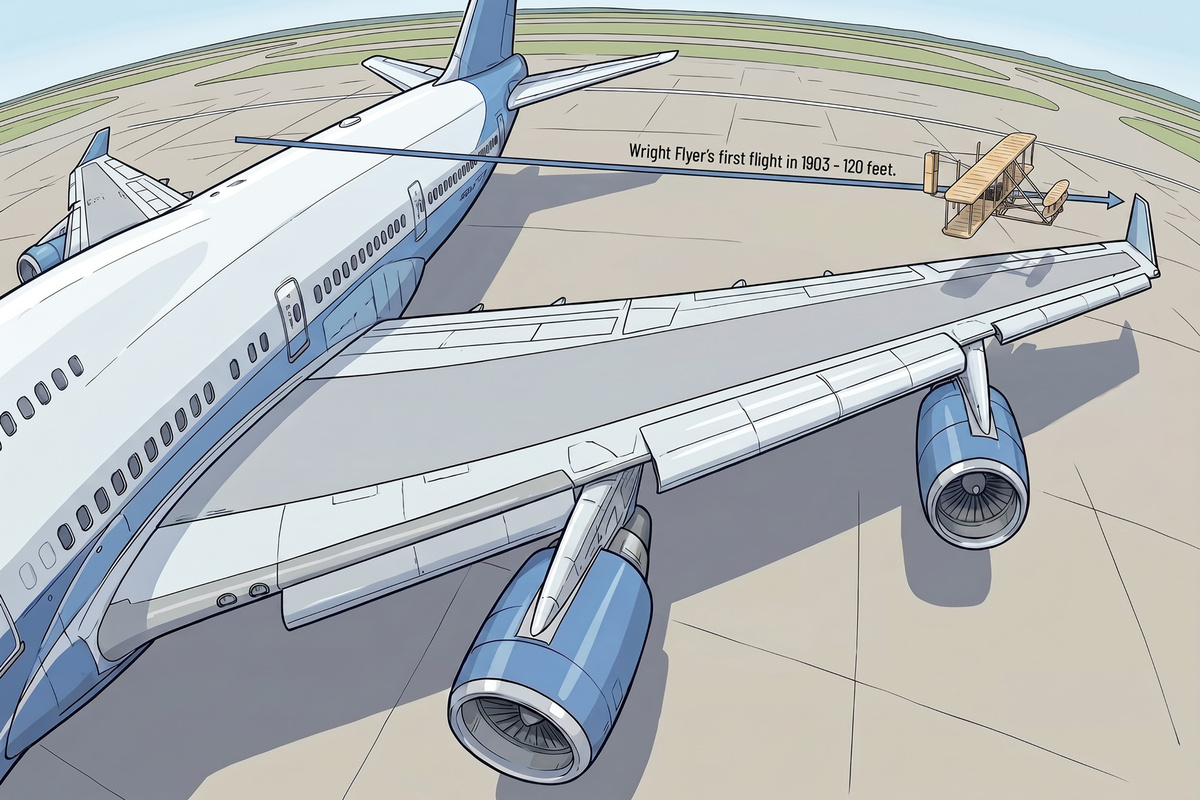
In 1903, a correspondent writing in the New York Times made a prediction. Human flight, he confidentially asserted, was so far beyond our reach that it might take mankind anywhere from one million to ten million years before the technical challenges could be solved.
It sounds absurd now, but by some reckoning, it was then felt to be a reasonable conclusion. For centuries, humans had dreamed of taking to the skies in heavier than air flying machines. Since the late 1700s people had of course flown in hot air and hydrogen filled balloons. In fact, in 1862 two intrepid aeronauts had ascended as high as 37,000 feet. But despite these successful balloon flights, heavier than air, controlled, powered flight had repeatedly eluded the world’s brightest engineers’ best efforts, and was thus presented as an impossible dream.
Yet, less than seventy days after that New York Times article, two bicycle mechanics from North Carolina proved it spectacularly wrong. In their first 12 second flight, the Wright brothers changed that future, in a metaphorical blink of an eye, erasing what had been thought to be millions of years of progress. At the same time, they changed the world into a completely new place that just a couple of months before no one could have imagined.
After that first step, the development of powered flight literally took off, and in just 66 years, the jet-powered 747 Jumbo, was cruising at 650 mph, 40,000 feet above sea level, ferrying 400 passengers across oceans from continent to continent.
Our problem is not our lack of imagination, but the notion that the post-present world will continue to be more or less the same as we know it to be now. Of course we hope (even believe), that the future will bring some, maybe even vast improvements, but few imagine the inevitable wholesale paradigm shifting changes that will make our future wholly unrecognisable to us.
We expect the future to be largely a continuation of the present, roads, airports, cities, jobs, money; we feel these things are sure, certain and dependable; but they are not. Look back one or two hundred years and mostly those things did not exist in a way that we would recognise today; spin forward one hundred years and in all likelihood they will not exist at all. Airports will lie empty or redeveloped, roads obsolete, money a thing of the past. Entire industrial complexes, built over decades, will contract or vanish within a generation.
So, right now somewhere, perhaps already in development, just round the corner, is the rocket engine equivalent of the Wright Flyer’s powered flight, a technology to fundamentally change the world and everything in it. It’s a breakthrough that will make our current puny chemical rockets feel as outdated as horse-drawn carriages and present us with opportunities the likes of which we can hardly even imagine. Roll on the exciting and extraordinary world of Advances in the Art of Being.
22 May 2026